

Bezalel pulse jet dust collectors pull airborne dust and particulate matter out of your plant air, reduce contamination at source and keep the working environment clean and breathable. Six standard models cover 6,200 to 35,000 m³/hr, and we build custom units and ducting for applications that fall outside the range.
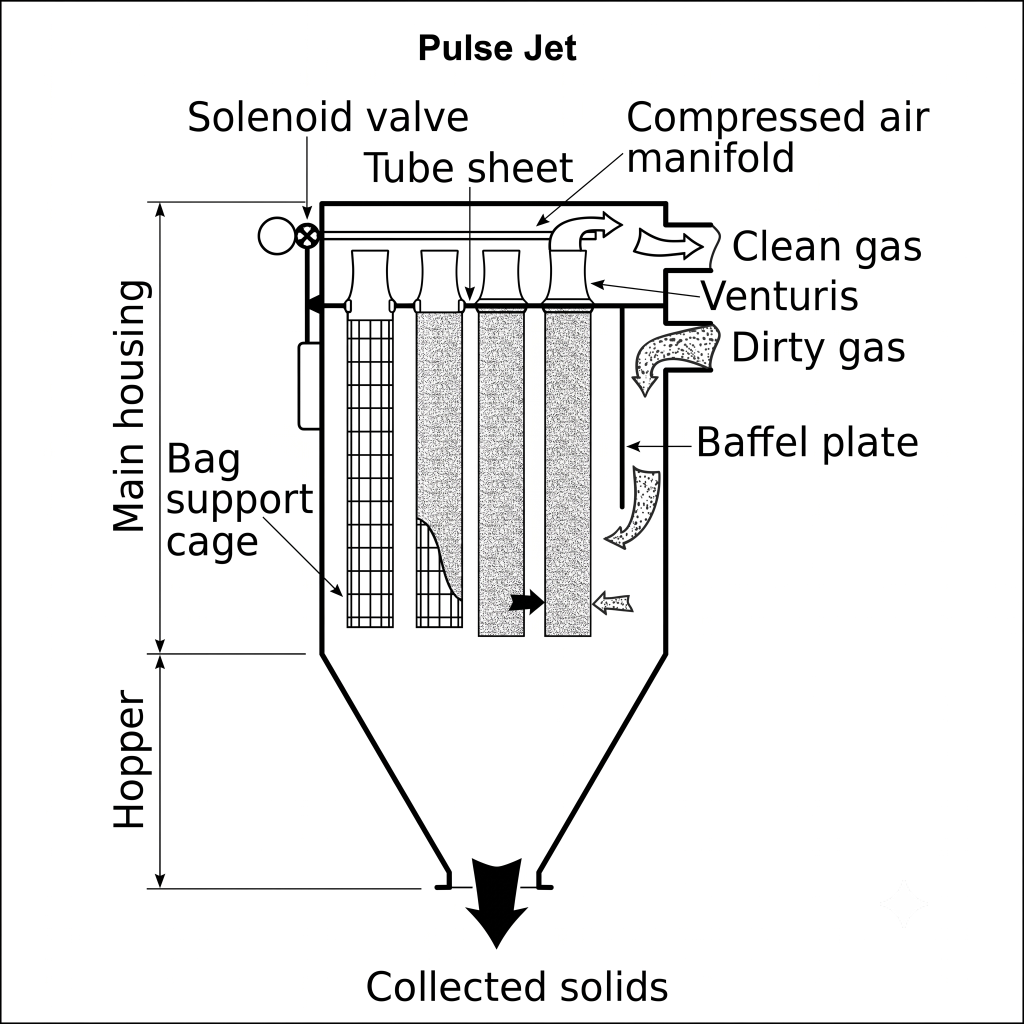
Dust-laden air enters the collector through the inlet. It first meets a baffle plate, which drops out the heavy particles before they reach the filter media — this protects the bags and cartridges from abrasion and impact damage, and is one of the main reasons filter life stays predictable.
The air then passes through the filter bags or cartridges. Dust is retained on the outer surface of the media while clean air passes through to the outlet. As the collector runs, the retained dust builds into a cake that gradually reduces the porosity of the media. Pressure drop rises and the ventilation volume of the collector falls.
To hold pressure drop at a moderate, stable level, the collector cleans itself continuously. A sequential timer controller actuates the solenoid valves on the compressed air header. Each valve releases a momentary high-pressure pulse of compressed air down the blow pipe and into the filter tube through a venturi. The pulse creates a reverse flow of air that expands the bag or cartridge sharply and releases the accumulated dust cake.
Cleaning runs row by row, so only a fraction of the total filter area is offline at any moment. Ventilation continues without interruption — you do not stop production to clean the collector. Dislodged dust falls into the hopper and discharges through a motorised rotary airlock valve.
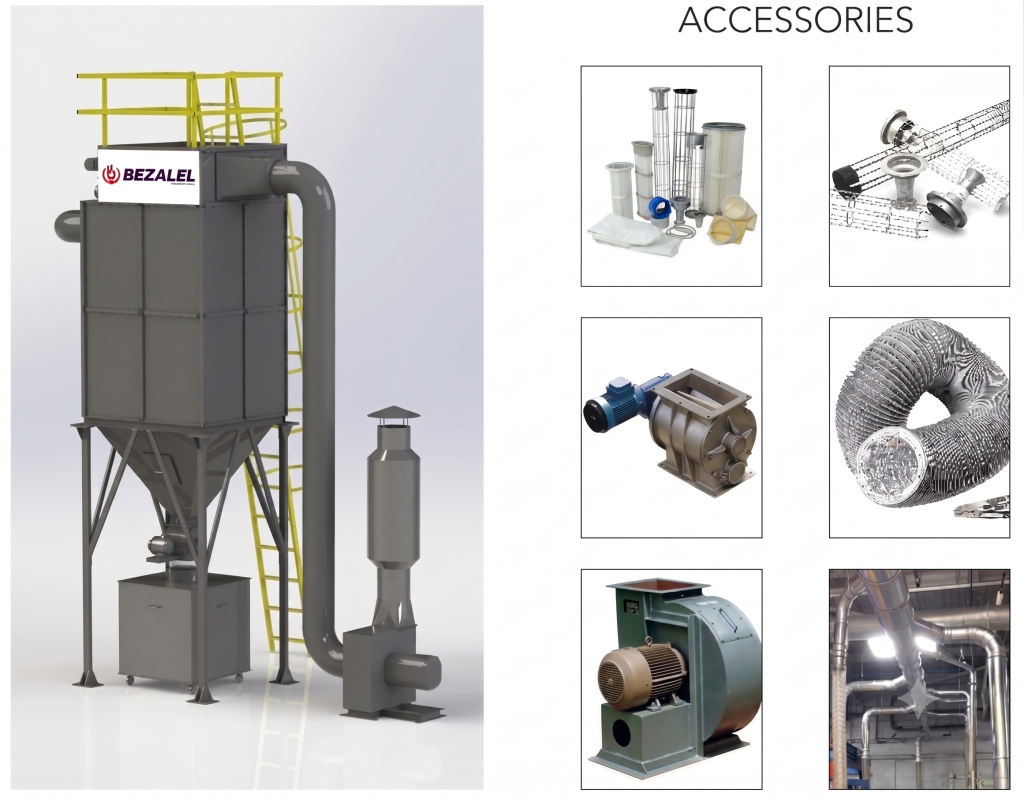
Model numbers follow the pattern PJ [motor HP] X [filter surface area in m²]. For example, PJ 30X120 is a 30 HP unit with 120 m² of filter surface.
| Model | Power HP (kW) | Air flow (m³/hr) | Filter surface area (m²) | Dimensions L × B × H (mm) |
|---|---|---|---|---|
| PJ 15X020 | 15 (11.25) | 6,200 | 20 | 1800 × 1200 × 6500 |
| PJ 20X083 | 15 (20) | 12,000 | 83 | 2500 × 1900 × 9000 |
| PJ 25X085 | 18.5 (25) | 13,000 | 85 | 2500 × 1900 × 9000 |
| PJ 30X120 | 30 (22.5) | 15,000 | 120 | 2600 × 2500 × 9000 |
| PJ 30X175 | 30 (22.5) | 15,000 | 175 | 3400 × 2800 × 9500 |
| PJ 60X280 | 60 (45) | 35,000 | 280 | 5000 × 2400 × 9700 |
We supply the full system, not just the collector shell. Every unit is matched with the filtration, discharge and air-moving components it needs to perform.